I was reading an opinion piece in The Hill about transgender athletes competing in women’s sports when a thought occurred to me.
The author argued there is no real compromise. One side views sports through the lens of gender identity while the other views them through the lens of biological sex and fairness. After years of arguing about it, I think he’s probably right.

Consideration of the various possible compromises that could exist yields only one conclusion: No.
The left’s preferred solution, sports participation based on gender identity, is unacceptable to most conservatives, some feminists and many parents who believe women’s sports exist to specifically protect competition based on biological differences between boys and girls.
The right’s preferred solution, participation based strictly on biological sex, is equally unacceptable to liberals and activists, who believe transgender students are entitled to school accommodations based on their “gender identity.”
[…]
Yet each proposal ultimately runs into the same obstacle. One side views the issue primarily as an issue of diversity, equity, inclusion and transgender rights. The other views it through the lens of fairness, safety and biological reality. Those are not merely policy disagreements — they are fundamentally different and irreconcilable world views. – The Hill
Still, I keep coming back to something much simpler.
When I was in high school, I knew I wasn’t athletic. I wasn’t fast. I wasn’t particularly coordinated. The Olympics were not calling my name.
So I did what most people used to do when they weren’t good at something.
I found something else to do.
I never demanded a spot on a team. I never expected coaches to lower standards for me. I certainly never thought my desire to participate should outweigh reality.
Not Every Door Is Meant To Open
That may sound harsh in today’s culture, but it used to be considered common sense.
Human beings are not equally talented at everything. Some people can sing. Some can build businesses. Some can fix an engine. Some can throw a football fifty yards.
The rest of us figure out what we’re good at and spend our time there.
Somewhere along the way, we stopped teaching that lesson. Instead, we started teaching that every door should open for everybody. If it doesn’t, there must be an injustice. If somebody is excluded, the rules must be changed.
That mindset shows up everywhere these days, but it is especially obvious in sports.
When Did Sports Become An Entitlement?
The assumption is that every athlete deserves a place to compete.
Why?
Sports have always involved winners, losers, starters, benchwarmers, and kids who never make the roster in the first place. That’s not a flaw in the system. That’s the entire point of competition.
I knew sports weren’t for me long before any coach had to tell me. If I had shown up demanding a spot on the team anyway, people would have looked at me like I’d lost my mind.
Yet when the conversation turns to transgender athletes, nobody seems willing to ask a very basic question. If a male athlete can’t compete successfully against other males, why is the answer changing women’s sports instead of accepting that maybe this particular activity isn’t the right fit?
For most of human history, people understood that not every path was meant for every person. Somewhere along the way, we started treating that idea as controversial.
🚨 One photo, one question: Is this fair? The debate over biological males competing in women’s sports continues as critics argue it undermines opportunities and competitive fairness for female athletes. https://t.co/K78n2SiLRd #WomensSports #TitleIX #Fairness
— Mark R Matthews (@MarkRMatthews) June 3, 2026
The Bigger Problem
What fascinates me about this debate is the assumption hiding underneath it.
The conversation always seems to begin with the idea that everybody deserves a place to compete. I’m not sure when we decided that. Sports have never worked that way. Some people are naturally gifted athletes. Some work hard enough to become one. Others look at a basketball, softball, or track team and realize pretty quickly that their talents probably lie elsewhere.
I fell into that last category.
As a female, I knew I wasn’t good enough to make any of the girls’ sports teams. Nobody had to tell me. I already knew it, and it never occurred to me that somebody should change the rules because I wanted an outcome I hadn’t earned.
That’s the part of this debate I struggle to understand.
If I wasn’t given a place on a girls’ team simply because I was a girl, why should a boy be given a place on a girls’ team when he can’t successfully compete against other boys?
Nobody considered my situation a crisis. It was simply part of growing up. You learned what you were good at, what you weren’t good at, and eventually found your place.
The Forgotten Lesson
What strikes me is how little confidence we seem to have in people anymore.
We act as though hearing no will destroy someone. Or that discovering a limitation is some kind of life-altering event. In reality, most people are far more resilient than that.
Finding out you’re not good at one thing is often how you discover what you’re actually good at. Remember when having to do tough stuff meant building character?
Had I spent my teenage years trying to force my way onto a sports team, I might have missed the things I was better suited for.
That’s not a tragedy. That’s life.
Life goes on anyway.
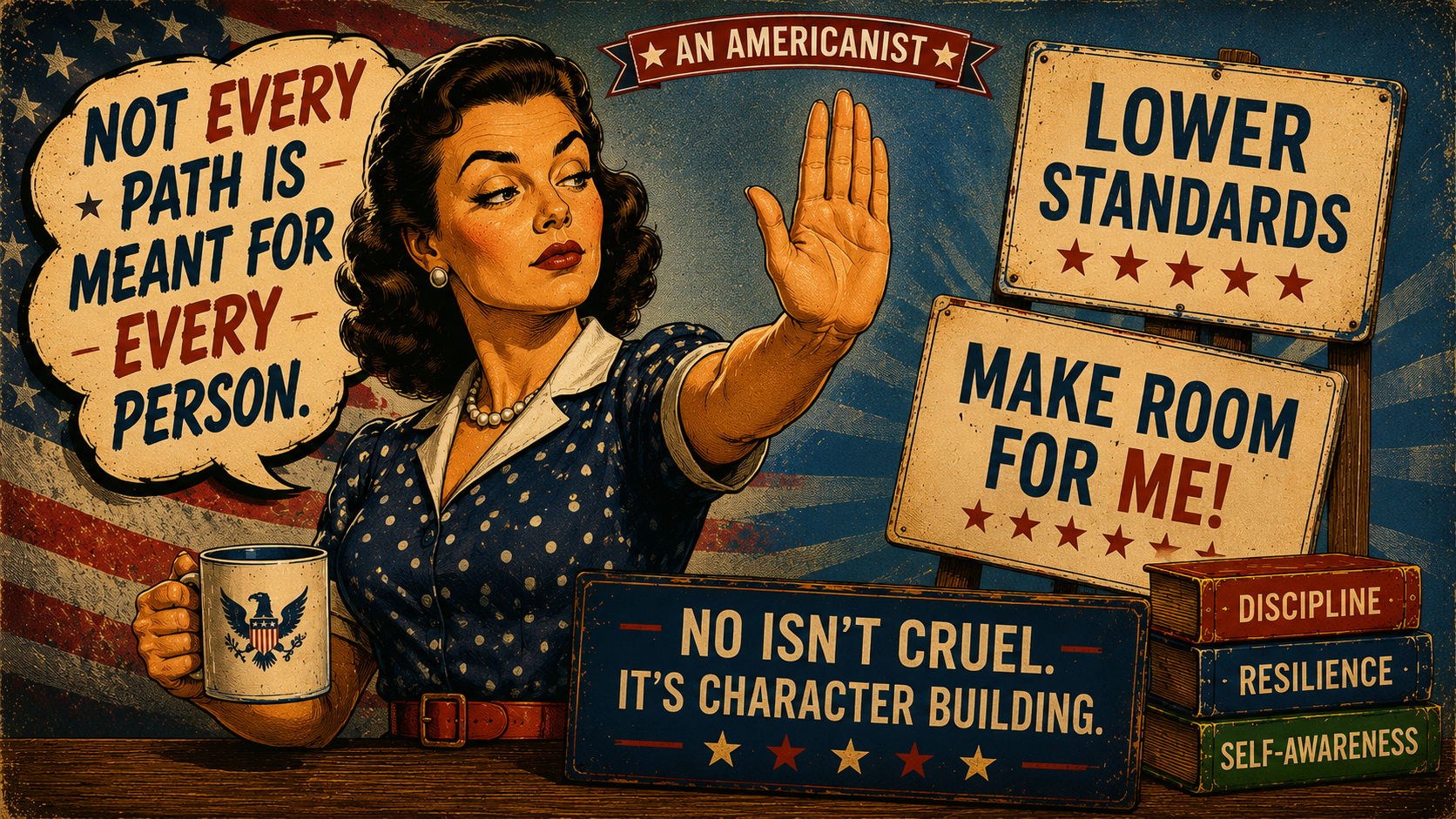
Feature Image: AI-generated illustration.