
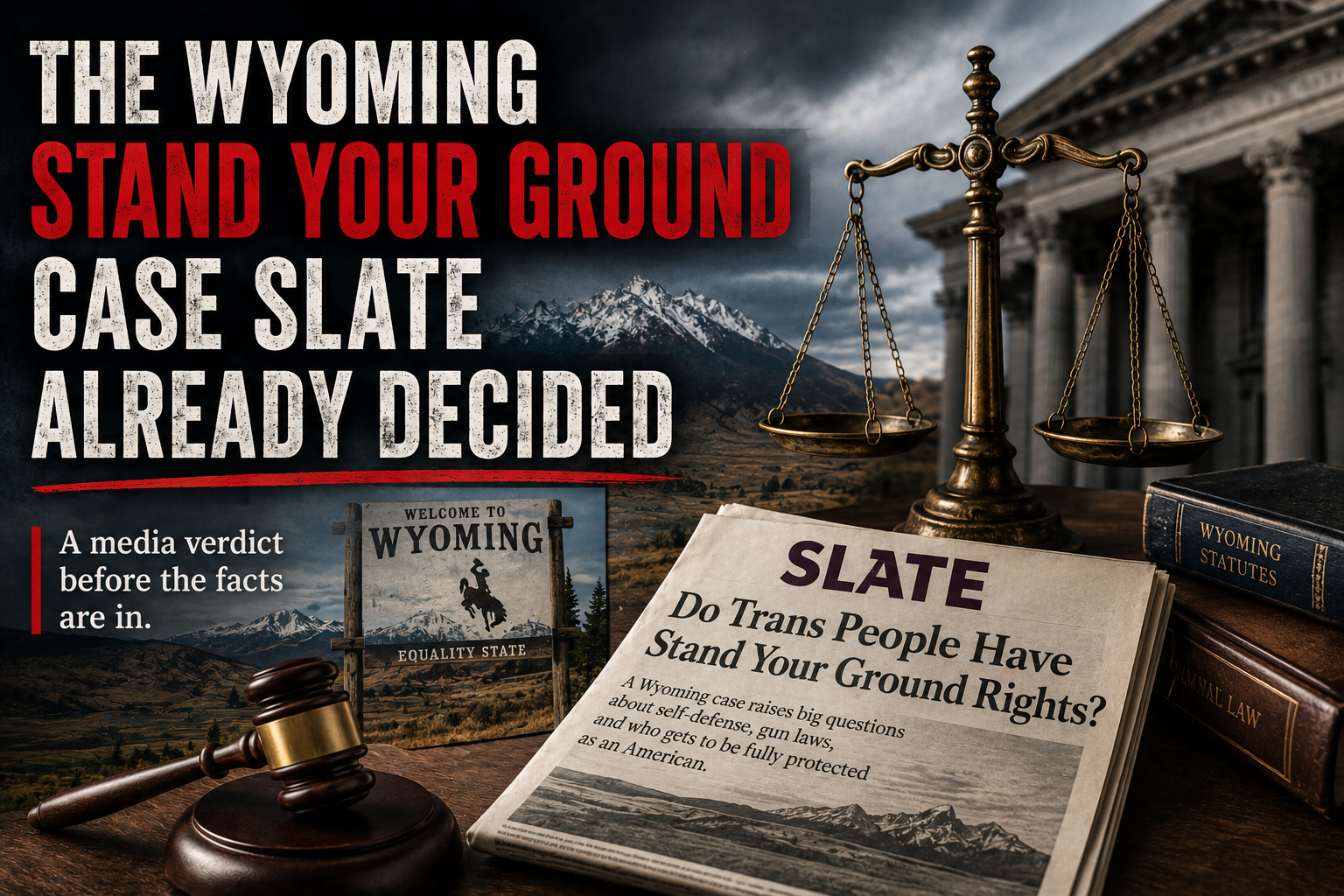
I came across a Slate article this week asking a provocative question: “Do Trans People Have Stand Your Ground Rights?” By the time I finished reading it, I found myself wondering something else entirely.
Did anyone bother to tell readers why the prosecutor filed charges in the first place?
The article centers on a Wyoming case involving a transgender defendant who claims to have acted in self-defense after being shoved to the ground outside a bar. Maybe the defendant acted lawfully. Maybe not. That’s what the court is supposed to determine. What struck me, however, was how little interest the article showed in that actual legal question. Instead, readers are steered toward a much larger conclusion: that Wyoming’s justice system may be denying transgender people the same rights enjoyed by everyone else.
That’s a serious accusation. The problem is that Slate seems eager to reach that conclusion before explaining why a prosecutor filed charges, why a judge found probable cause, or why the case is headed to trial at all.
Video evidence confirms that Kelver was alone, outnumbered, physically assaulted, and left on the ground facing multiple aggressors. So she pulled a gun. https://t.co/IUiCzlCB69
— Slate (@Slate) June 7, 2026
The Paragraph Slate Forgot To Write
If you’re going to argue that a prosecution is unjust, the least you can do is explain why prosecutors believed they had a case.
Slate walks readers through political context, historical examples involving other transgender defendants, and a broader discussion about gun rights and citizenship before ever addressing the question at the center of the case.
What it never really gives readers is the argument that convinced a Wyoming prosecutor to bring charges or a judge to let the case proceed.
That omission matters.
The article repeatedly suggests that the prosecution itself is evidence that something unfair is happening. Yet readers never learn why law enforcement believed the defendant’s conduct might have crossed the legal line from self-defense into aggravated assault.
If the answer is obvious, Slate never tells us.
Also, if you’d like a more detailed look at the facts of the case, the Cowboy State Daily has done a far more thorough job of laying them out than Slate ever bothered to.

The transgender Laramie resident who staged a protest at the state Capitol last summer of Wyoming’s new cross-sex access ban for public restrooms is now waging a self-defense argument in a felony aggravated assault case.
Rihanna Kelver, 26, made headlines last summer for using the women’s bathroom in the Wyoming Capitol when a new state law activated banning the practice.
The ban doesn’t allow for penalties against a transgender person using the women’s bathroom, but allows females aggrieved by that event to sue the state for letting it happen. – Cowboy State Daily
A Case About Law Or A Case About Identity?
Part of the answer may lie in the author’s background.
Caroline Light is not a criminal defense attorney. She is a historian whose research focuses on citizenship, belonging, and the ways American institutions treat different groups. She has also written extensively about self-defense laws and gun rights.
Viewed through that lens, the article makes more sense.
The case is not really presented as a dispute over the facts. It is presented as a test of whether transgender Americans receive the same protections as everyone else.
That is an interesting question. It is not necessarily the question before the court.
The jury is not being asked whether transgender people are full citizens. The jury is being asked whether this particular defendant’s actions qualified as lawful self-defense under Wyoming law.
Those are two very different inquiries.
Rights Or Permissions?
One point the article gets right is that rights should apply equally to everyone.
If Wyoming’s self-defense laws protect citizens who reasonably fear for their safety, then those protections should apply regardless of race, religion, political affiliation, sexual orientation, or gender identity.
The law does not belong exclusively to a certain group. If the defendant acted within Wyoming’s self-defense laws, then the defendant should receive the same protections available to every other citizen. Regardless if he was wearing a dress.
The problem is that Slate largely skips over the question the legal system is actually trying to answer. Did the defendant act within the law? That is the issue before the court.
The article instead nudges readers toward a different conclusion: that the prosecution itself is evidence of discrimination.
Those are not the same thing.
There is a difference between saying someone was charged and saying someone was charged because they are transgender. The article assumes the second proposition long before it establishes it.
Everybody Wants To Be The Jury Now
This is hardly a problem unique to Slate.
Increasingly, Americans seem unwilling to wait for facts, evidence, testimony, and verdicts before deciding who is right. The moment a story breaks, social media declares a winner and a loser. Activists pick a side. Journalists begin constructing a narrative. By the time the case reaches a courtroom, many people have already decided what the outcome should be.
That impulse exists across the political spectrum, but it has become especially common in modern advocacy journalism. The goal is no longer to explain a dispute or explore competing interpretations of the facts. The goal is to persuade readers that the dispute has already been resolved and that anyone who disagrees is standing in the way of justice.
The Slate article follows that pattern. Readers are encouraged to view the prosecution itself as evidence of wrongdoing rather than asking why prosecutors and a judge believed the case warranted further review in the first place.
Let The Jury Do Its Job
The issue isn’t whether transgender Americans are entitled to the protection of the law. They are. The issue is whether this particular case meets the legal standard for self-defense. Those are not the same question, no matter how badly activists and commentators want them to be.
The problem is that Slate appears far more interested in proving discrimination than examining whether the legal standard for self-defense was actually met.
A jury may ultimately conclude that they did. If so, the legal system will have worked exactly as intended.
What struck me most about Slate’s article is not its sympathy for the defendant. It is the certainty with which the article treats an unresolved legal dispute. Before the evidence has been fully tested and before a jury has weighed the facts, readers are encouraged to believe the real issue has already been settled.
Feature Image:


