
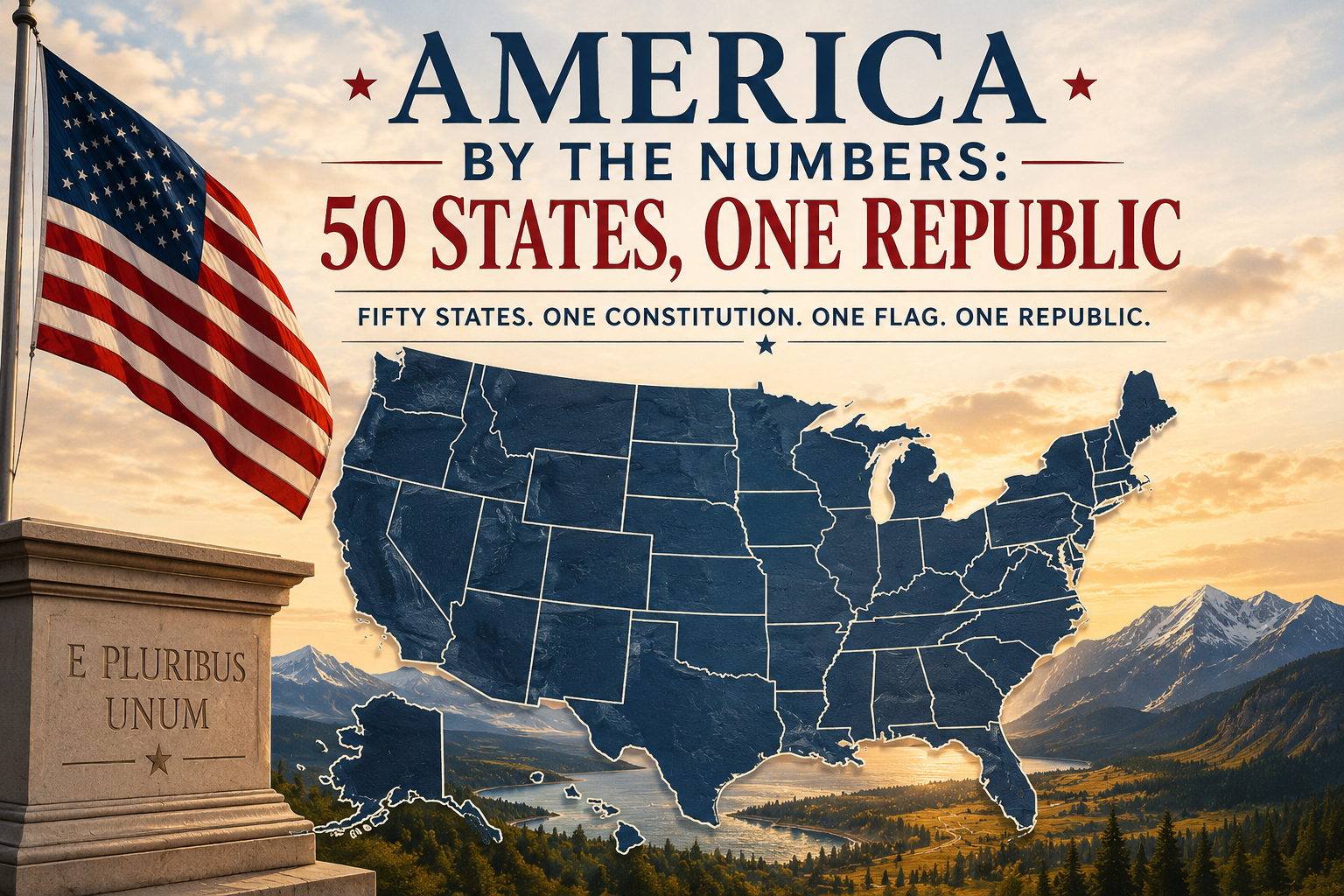
There are plenty of countries with provinces, regions, or administrative districts. America has states.
That distinction matters because the Founders never intended for every important decision to come from one capital city. They built a republic where power would be shared between the federal government and the states, allowing new states to join the Union while preserving the principle of local self-government under one Constitution.
The Constitution intentionally divides power because the Founders believed liberty was better protected when no single government held all the cards.
By the Numbers
50 States
The United States is made up of fifty states, each with its own constitution, elected leaders, courts, and laws.
Delaware became the first state to ratify the Constitution on December 7, 1787.
Hawaii became the fiftieth on August 21, 1959.
Between those two milestones lies the story of a growing nation that expanded across a continent without abandoning the idea that local government still matters.
13 Original Colonies
Every state in the Union traces its roots to thirteen colonies that chose independence over remaining subjects of the British Crown.
Those colonies didn’t simply replace one king with another powerful central government. They created a constitutional republic that divided power, limited government, and recognized that the states themselves would remain an essential part of the American experiment.
50 Different Ways to Be American
Every state has its own constitution, its own government, and its own way of doing things.
That wasn’t an accident. The Founders created a system that divided power between the federal government and the states, allowing communities to govern many of their own affairs while remaining united under one national Constitution. The Tenth Amendment reinforced that principle by reserving powers not delegated to the federal government to the states or to the people.
The result is fifty states that don’t all look alike, vote alike, or govern alike.
Texas doesn’t look like Vermont.
Alabama doesn’t govern like California. (Thank the Lord above).
Arizona isn’t Maine.
That’s not a flaw in the American system. It’s one of its greatest strengths. Americans don’t have to agree on every policy to remain one nation. Federalism allows states to reflect the people who live there while preserving the republic that binds them all together.
1 Constitution
This may be the most important number of all.
Every state has its own government, but all fifty are bound together by one Constitution.
That document defines the powers of the federal government while reserving many others to the states and to the people. It doesn’t eliminate differences between states. It protects their ability to govern themselves in many areas while preserving the Union.
In an age when Washington often seems eager to decide everything, it’s worth remembering that America was never designed to operate as one giant state.
50 Different Ways to Be American
Spend a week in rural Montana, downtown Boston, the Mississippi Delta, the Arizona desert, or coastal Maine, and you’ll quickly discover there is no single American lifestyle.
- We speak with different accents.
- We cook different foods.
- We cheer for different teams.
- We build different industries.
- We even disagree about how some laws should work.
None of that weakens the country.
It’s one of the reasons the country works.
Federalism allows states to reflect the people who live there instead of expecting 340 million Americans to agree on every policy from one office building in Washington.
That flexibility has helped hold together one of the most geographically large and culturally diverse republics in history.
The Long View
As America approaches its 250th birthday, it’s easy to focus on what divides us.
Politics certainly does.
But the story of America has never been about creating fifty identical states. It has been about creating one republic where fifty different states could thrive together under the same Constitution.
The Founders understood something that still holds true today: unity doesn’t require uniformity.
It requires a shared commitment to the principles that hold the country together.
Fifty states. One Constitution. One flag. One republic.
Nearly 250 years later, that’s still one of America’s greatest achievements.
Feature Image: AI-generated illustration.
