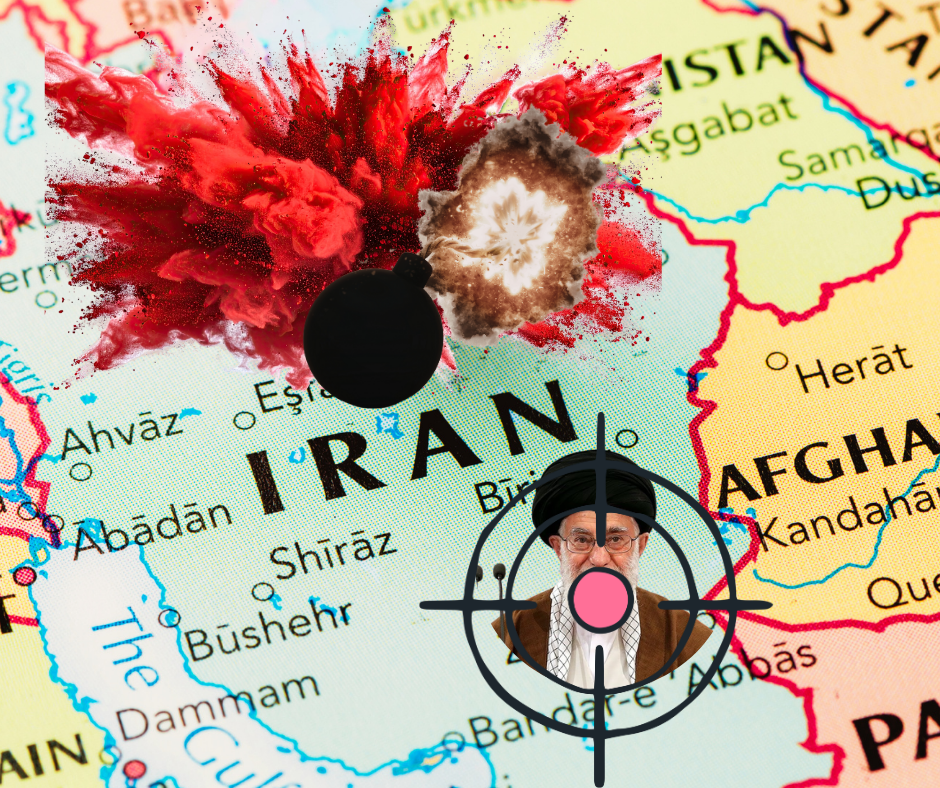
When news broke that the United States had launched strikes against Iran’s leadership, my first reaction was probably the same as many Americans. Iran’s regime has spent decades chanting death to America, funding terrorist proxies, and threatening Israel. Under those circumstances, the instinctive response was simple enough. Well now. Okay then. Go get ’em, about damned time.
🚨 BREAKING: The leader of the Iranian unit who was the architect of the assassination plot against President Trump has been KlLLED, per Pete Hegseth
“Iran tried to kill President Trump. And President Trump got the last laugh.” 🔥 pic.twitter.com/YcWRSGYSo6
— Nick Sortor (@nicksortor) March 4, 2026
But the longer I sat with it, the more complicated that reaction became. I support President Trump and understand the argument for hitting a regime that has spent forty years acting like a hostile power. At the same time, a little voice in the back of my mind kept asking a question that history keeps asking every time the Middle East erupts. If you remove the people running the regime, who exactly replaces them?
That is where the skepticism creeps in. We have watched versions of this story unfold before. When the United States takes out leaders, governments shake for a while and eventually another hardliner ends up sitting in the same chair. Regimes built around ideology rarely disappear just because a few people at the top are gone. Removing the man is one thing. Removing the belief system behind him is another.
When Political Opposites Start Asking the Same Question
Politics occasionally produces moments that feel like one of those old cartoons where the characters run in opposite directions and somehow crash into each other in the middle of the street. The anti-war left and the populist right are not supposed to be standing anywhere near the same argument. Normally they are busy accusing each other of destroying the country for completely different reasons. Yet here they are, looking across the political divide and realizing they have wandered into the same conversation.
What makes this moment politically interesting is that the mixed reaction is not confined to one political camp. Progressive anti-war activists are warning about escalation and the possibility of another long Middle East conflict. Libertarians are raising similar concerns about intervention and the limits of military force. Even parts of the populist right, a movement normally associated with hardline rhetoric toward Iran, have found themselves debating whether strikes like this fit comfortably inside the “America First” instinct that helped shape the last decade of politics.
The reactions are not perfectly partisan either. While most Democrats criticized the strikes, Pennsylvania Senator John Fetterman surprised some observers by praising the move and arguing that Iran’s regime had pushed the region toward confrontation for years. Moments like that remind you that foreign policy debates do not always follow the neat partisan lines we expect.
🚨 JOHN FETTERMAN after being briefed on Iran by Secretary Rubio:
“I think they just blew up 80 of Iran’s mullahs too. Which, I mean, that was pretty great actually!”
Dude’s gonna get himself kicked out of the Democrat party 🤣🔥 pic.twitter.com/P4XiffIZ4H
— Nick Sortor (@nicksortor) March 3, 2026
That does not mean everyone agrees about the strike itself. Many Trump supporters strongly support the decision and see it as a necessary response to a regime that has spent decades provoking confrontation. Others, like me, support the president but still wrestle with the longer-term question about whether actions like this actually change the system behind the regime.
Skepticism Born From Experience
Part of the reason Americans wrestle with these questions is that Washington’s foreign policy record over the last quarter century has not exactly inspired confidence. Iraq was supposed to stabilize the region. Afghanistan was supposed to eliminate the threat that produced 9/11. Libya was supposed to usher in a more democratic Middle East. Each intervention came with assurances that the situation was under control and the long-term strategy was sound. Americans listened, watched the outcomes unfold, and learned to take those assurances with a grain of salt.
That lingering skepticism is not necessarily isolationism. It is the natural reaction of a country that has seen how complicated these conflicts can become once the initial strike or intervention fades into the background. People are not just asking whether Iran deserved to be hit. They did, for a long time. Many are quietly asking the harder question about what comes next.
What this moment really reveals is how much the political map has changed. The old labels still exist, but they do not explain the reactions the way they once did. The same country that once divided neatly between hawks and doves now contains a much broader skepticism about foreign intervention, and that skepticism no longer belongs to just one party. It shows up on the left for one set of reasons and on the populist right for another, but the underlying instinct is remarkably similar.
When people who normally disagree about almost everything suddenly find themselves circling the same uneasy questions, it is usually a sign that something deeper in the country’s mood has shifted.
Feature Image: Tasnim News Agency, CC BY 4.0, via Wikimedia Commons


