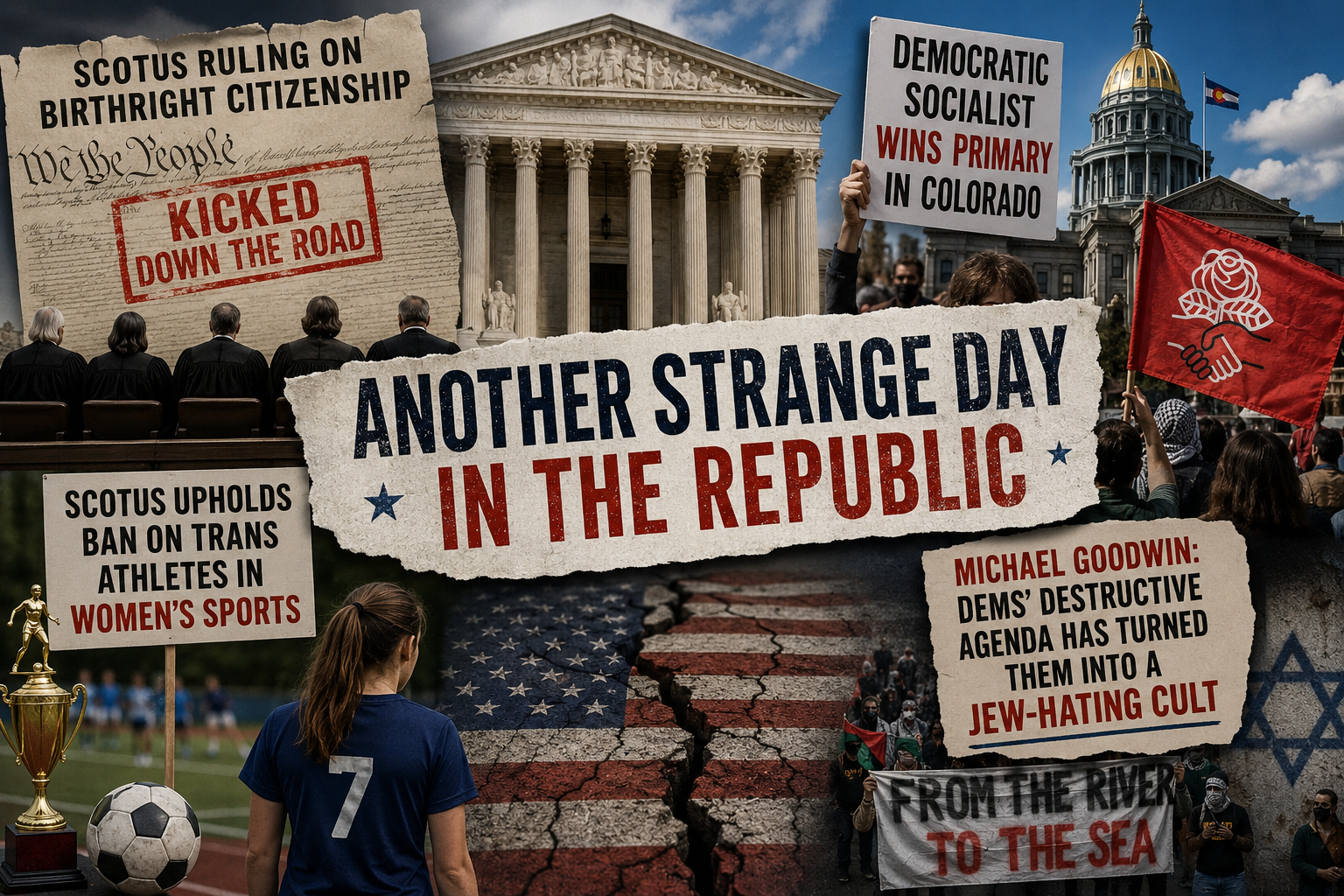
Some days, the headlines practically write the column.
Today was one of those days.
The Supreme Court issued two major decisions. Colorado Democrats nominated another democratic socialist. And a growing debate over antisemitism inside the Democratic Party became even harder to ignore.
At first glance, those stories don’t seem to have much in common. But after reading through all of them, I kept coming back to the same thought: we’re watching the country argue over some of its biggest questions all at once. The Constitution. Immigration. Women’s sports. Socialism. Israel. They’re different stories, but they’re all part of the same conversation about what kind of country America is becoming.
SCOTUS Draws a Constitutional Line
The Supreme Court made the biggest news of the day with its 6-3 ruling striking down President Trump’s executive order ending automatic birthright citizenship.
The Court held that the order violated the Citizenship Clause of the Fourteenth Amendment, effectively saying that changing birthright citizenship can’t be done with the stroke of a presidential pen.
Supporters are celebrating the ruling as a victory for the Constitution.
NEW: The Supreme Court has upheld birthright citizenship, blocking Trump’s campaign to dismantle the 14th Amendment and its protections for the children of immigrants.
The Constitution is clear: If you were born here, you are an American citizen. No one can change this fact. pic.twitter.com/AezCQWelgN
— Democrats (@TheDemocrats) June 30, 2026
Others see it as another example of the Court refusing to reconsider how a nineteenth-century amendment should apply to a twenty-first-century immigration system that looks nothing like the one the authors of the Fourteenth Amendment could have imagined.
Whatever side you land on, one thing is certain. Immigration isn’t going away as a political issue, and neither is the argument over birthright citizenship. The Court issued its opinion, but I have a feeling this debate is only getting louder.
A Win for Women’s Sports
The second Supreme Court headline landed very differently.
The justices allowed states to continue enforcing laws protecting women’s sports by keeping biological males out of female athletic competition while legal challenges continue.
For a lot of Americans, that wasn’t controversial. It was common sense.
Supreme Court upholds state bans on trans athletes in girls’ sports. Read today’s cover here: https://t.co/Q2WgV7UBqI pic.twitter.com/1VYMNCshtE
— New York Post (@nypost) July 1, 2026
Women’s sports exist because biology matters. That’s the entire reason separate women’s competitions were created in the first place. Protecting those opportunities shouldn’t require endless lawsuits or explanations for acknowledging something most people understand instinctively.
For today, common sense managed to stay on the scoreboard.
Colorado Joins the Party
Apparently, New York isn’t the only place embracing democratic socialism.
Colorado Democrats nominated another socialist, adding to a growing list of candidates riding the same political wave that’s already reshaped politics in places like New York, Chicago, Minneapolis, and Seattle.
There was a time when politicians tried to avoid the socialist label.
Now some campaign on it.
Democratic leaders can insist this is still the party’s fringe, but these candidates keep winning primaries. At some point, it becomes fair to ask whether this is where the party is headed or whether the party is simply following where its most energized voters have already gone.
The Democratic Party Has Another Problem
The fight over socialism gets most of the attention. I’m beginning to think something else deserves even more.
Michael Goodwin has an excellent column in today’s New York Post arguing that the Democratic Party is facing a growing problem with antisemitism that too many leaders are unwilling to confront.

For much of the past 50 years, Democrats were the most ardent and consistent supporters of Israel.
At the same time, in many Jewish households, being a Dem and voting for the party’s candidates became near-religious rituals.
Jews played pivotal roles in the civil rights movement, and have been in the forefront of most liberal causes ever since.
But the party has changed dramatically in recent years.
Barack Obama started his presidency by apologizing to Arabs for America’s Mideast policies.
Beyond his ignorance about much of that history, he demonstrated complete disdain for Israeli Prime Minister Benjamin Netanyahu.
Along with his championing Palestinian causes, the moves made Obama the most unpopular American president in Israel since its post-World-War 11 founding.
It’s now clear that the Obama years opened the door for an even bigger shift in the Dems’ view of Israel, which has declined sharply in the past three years.
The oddest thing is what propelled it to change so quickly.
Pollsters have noted a decided turn against Israel since the savage Oct. 7, 2023, Hamas terrorist attack.
A February Gallup survey reported that only 33% of Democrats say they are pro-Israel, while 60% say they view our close ally unfavorably.
Gallup says that is the first time a majority of any political party held negative views on the Jewish state since the question was first asked in 1989.
It’s becoming harder to ignore what’s happened since October 7.
Support for Israel has dropped sharply among Democratic voters. Anti-Israel protests have become common on college campuses. Slogans that many Jewish Americans hear as calls for Israel’s destruction are increasingly dismissed as simply another form of political expression.
Organizations like the Anti-Defamation League have repeatedly warned that antisemitism is becoming more visible and more socially acceptable than it was just a few years ago. That should alarm anyone who believes hatred has no place in American politics. There’s a world of difference between criticizing the policies of the Israeli government and excusing rhetoric that targets Jewish people or calls for the elimination of Israel. Lumping those together may be politically convenient for some activists, but it doesn’t make them the same thing.
Four Stories, One Direction
When I started writing this column, I honestly thought I was just putting together a quick roundup of the day’s headlines.
The more I thought about it, the more I realized these stories weren’t random at all.
One story asked what the Constitution means. Another asked whether biological reality still matters. Another showed socialism continuing to gain ground inside Democratic primaries. And another raised uncomfortable questions about whether one of America’s two major political parties is willing to confront antisemitism inside its own coalition.
Those aren’t isolated debates. They’re all arguments about the country’s direction.
Maybe that’s why today’s news cycle felt so heavy. It wasn’t because there was one huge story. It was because there were four stories, all pulling on the same thread.
Feature Image: AI-generated illustration.