
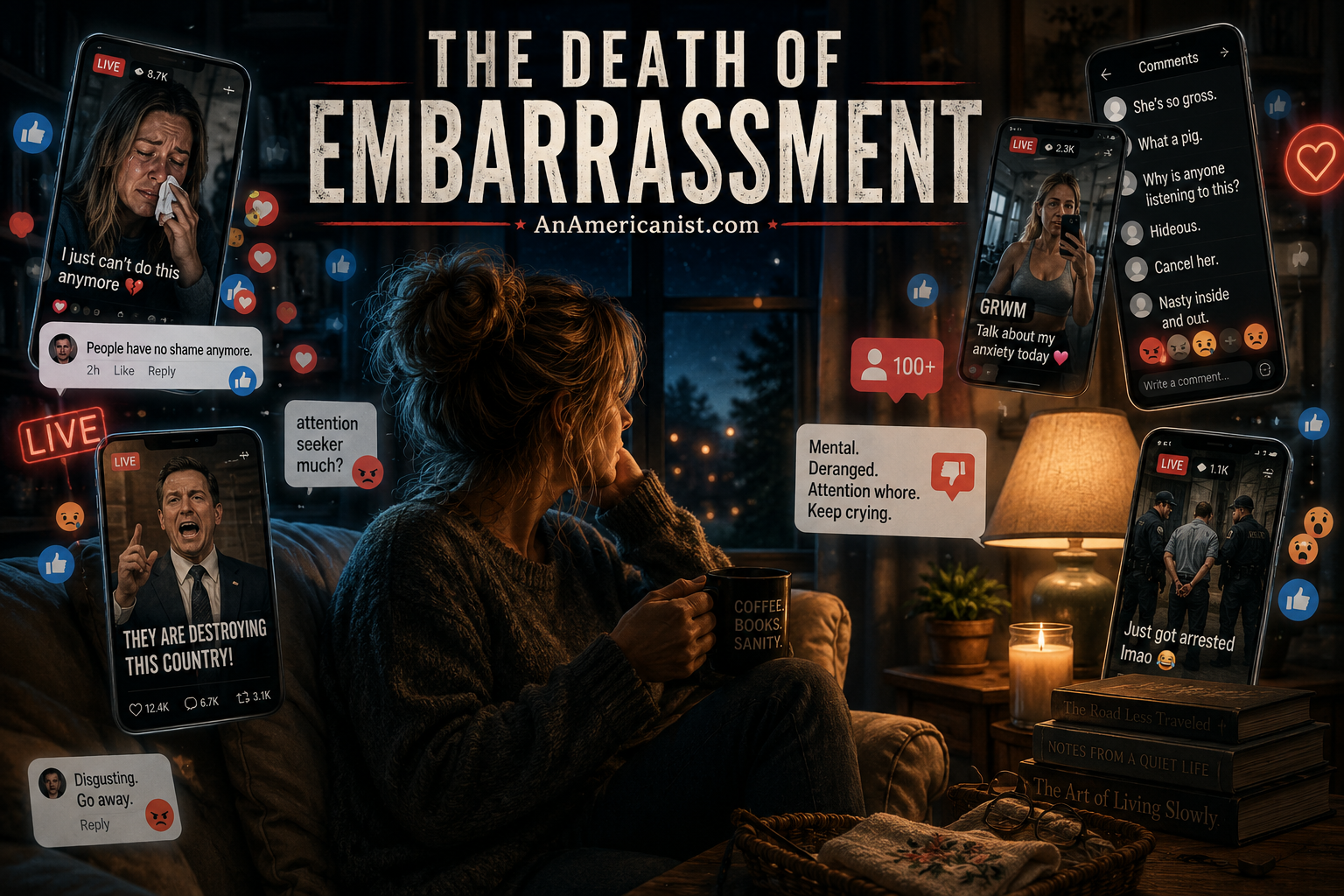
I do not know exactly when Americans became comfortable filming themselves crying in parked cars, but apparently we all agreed to it somewhere along the way. Every day the internet serves up another emotional breakdown recorded directly into a phone camera while complete strangers sit in comment sections offering therapy advice, relationship analysis, political arguments, or flat-out mockery for entertainment.
@thee_wild_bill 🤣#meme #memes #ladyscreamingincar #eletions2024 #electionday #presidentoftheunitedstates #thebackrooms #silenthill ♬ original sound – Wild Bill
At the same time, somebody else is under a ring light discussing divorce, trauma, family drama, or a mental-health spiral while casually applying foundation during a “Get Ready With Me” video like emotional collapse is now part of a skincare routine. The strangest part is that none of this even feels strange anymore.
Somewhere along the way, embarrassment died.
Not shame in some deep moral sense. I mean ordinary embarrassment. The kind that reminded people not every emotional moment, personal struggle, family argument, or half-formed thought needed a public audience. There used to be a line between public life and private life, and while people certainly overshared before social media, there was still usually some instinct telling them to keep a few things to themselves.
That instinct barely exists now.
Everything Became Performance
The internet did not just change how people communicate. It changed how people behave.
Americans now move through life like they are starring in their own reality show. Every opinion becomes content. Every inconvenience turns into a speech. Every emotional reaction becomes something to document for strangers online.
A person can no longer simply have a bad day. They sit in the front seat of a Honda Civic explaining the emotional meaning of the bad day to TikTok while soft piano music plays underneath.
Social media convinced people they should behave like influencers even when nobody asked. Women now start Facebook reels standing around in underwear before revealing an outfit like they are auditioning for a reality show filmed beside the air fryer. Nothing can simply exist anymore without becoming content for strangers online.
Nothing stays private anymore because modern culture increasingly treats privacy itself like wasted content.
Some Things Used To Stay Behind Closed Doors
There was a time when certain parts of life stayed behind closed doors. Arguments stayed inside the family. Emotional breakdowns remained between close friends. Personal struggles existed without an audience sitting nearby waiting to react. Even behaviors or identities people knew society might side-eye often stayed personal instead of becoming somebody’s full online brand.
I just spoke about women getting ready in front of the camera, and I want to make a clear distinction here. The next clip I am sharing is not about women getting ready because clearly, this man is not a woman. I am only sharing the clip to emphasize how people’s fetishes, perversions, and deeply personal behavior are now constantly pushed all over social media and public spaces like the rest of us are simply expected to accept it as normal.
I wonder what his target group is? 🤣🤣🤣🤣 pic.twitter.com/UXRgy3Qw7b
— TERFs ‘r’ us ©️ (@Terfs_R) May 21, 2026
Now everything gets pushed into public view where strangers either applaud, validate, encourage, diagnose, or humiliate it.
Americans no longer simply experience life. They perform themselves experiencing life.
The Internet Rewarded The Least Self-Aware People
Social media did not reward restraint. It rewarded exposure, and the louder, stranger, angrier, or more emotionally exposed somebody became online, the more attention they usually received in return. Followers became validation, while oversharing somehow transformed into authenticity, which created a culture where constant self-exposure now feels normal instead of uncomfortable.
The natural pause between thought and broadcast disappeared.
People no longer stop and ask themselves whether something should be shared publicly. The only question now seems to be whether it will generate clicks, outrage, sympathy, reactions, or engagement. That shift may explain why modern life feels emotionally exhausting even when people log off social media itself. Everybody performs all the time now because the internet trained people to think visibility equals importance.
False confidence replaced self-awareness.
That may sound harsh, but look around for five minutes online and tell me it is not true.
The Audience Changed Too
The problem is not just the people posting every emotional breakdown online. The audience changed too, and in some ways that may be even uglier.
People no longer simply observe public behavior online. They pile on. They compete to deliver the nastiest insult, the harshest joke, or the cruelest comment because humiliation itself became entertainment somewhere along the way. You can see it every single day in comment sections where complete strangers tear apart somebody’s appearance, mental state, relationships, intelligence, or personal struggles like they are reviewing a television character instead of talking about another human being.
Disagreement now immediately escalates into public savagery.
I can completely disagree with somebody politically and still not feel the need to publicly degrade them as a person. That should not be considered some heroic act of restraint. It should be basic adulthood. Instead, social media increasingly rewards cruelty because cruelty generates engagement, reactions, screenshots, quote posts, and attention.
Even the spectators are performing now.
Modern internet culture turned ordinary people into both entertainers and bloodthirsty audiences at the exact same time.
Politics Became Content Too
It was only a matter of time before this behavior spilled directly into politics.
Members of Congress now behave like influencers with government credentials while political commentary increasingly resembles livestream theater designed for clipping, outrage, and social-media engagement instead of persuasion. Public figures constantly feed the algorithm with emotional reactions, personal branding, outrage bait, and attention-seeking behavior because visibility itself became a form of power online.
The internet rarely rewards the thoughtful person, the quiet person, or the individual willing to pause before emotionally broadcasting every reaction to the world. The people who dominate online spaces are usually the people least afraid of exposure, humiliation, oversharing, or public conflict.
That changes culture over time.
Americans slowly became conditioned to believe that if nobody online reacts to something, it somehow does not matter. That is a miserable way to live because human beings were never designed to exist inside a permanent public performance.
People Are Quietly Pulling Back
At the same time, I think a lot of people are growing exhausted by all of this, even if they cannot fully explain why.
The pressure to constantly post, react, share, document, perform, brand yourself, and emotionally participate in every cultural moment leaves people mentally worn down in ways they do not always recognize immediately. You can almost feel people quietly retreating from it now. Some are reading books again. Some are listening to music without posting screenshots of it. Others are gardening, crafting, cooking, sewing, walking, or simply trying to reclaim small private corners of life that do not require validation from strangers online.
People want parts of themselves back.
Not everything needs photographed. Not every emotional reaction needs posted publicly. Not every private moment requires an audience sitting nearby waiting to react in real time.
Maybe embarrassment existed for a reason after all. Not to silence people or make them ashamed of themselves, but to remind human beings that some parts of life were still allowed to remain private.
Feature Image: AI-generated illustration

This is such a thought-provoking article, I’ve never really viewed it as losing our sense of embarrassment. Privacy yes, but the lack of (shame?) is an interesting angle. I’m also happy it ends on a hopeful note. Thanks Carol 😀
Thank you for taking the time to read, and commend!