A certain segment of America has spent years lecturing the rest of us about the importance of diversity. Diversity makes us stronger, smarter, and better. Entire industries have sprung up around the idea.
It all sounds like a great idea until diversity moves into the neighborhood.
That was my first thought while reading a recent NPR article about what researchers call the Great American Sort, the growing trend of Americans moving from red states to blue states and blue states to red states.
The article profiled a transgender activist who left Texas for Seattle and a conservative radio host who left Seattle for Texas. On the surface, the story was about politics. The more I thought about it, however, the more it seemed to be about something much bigger.
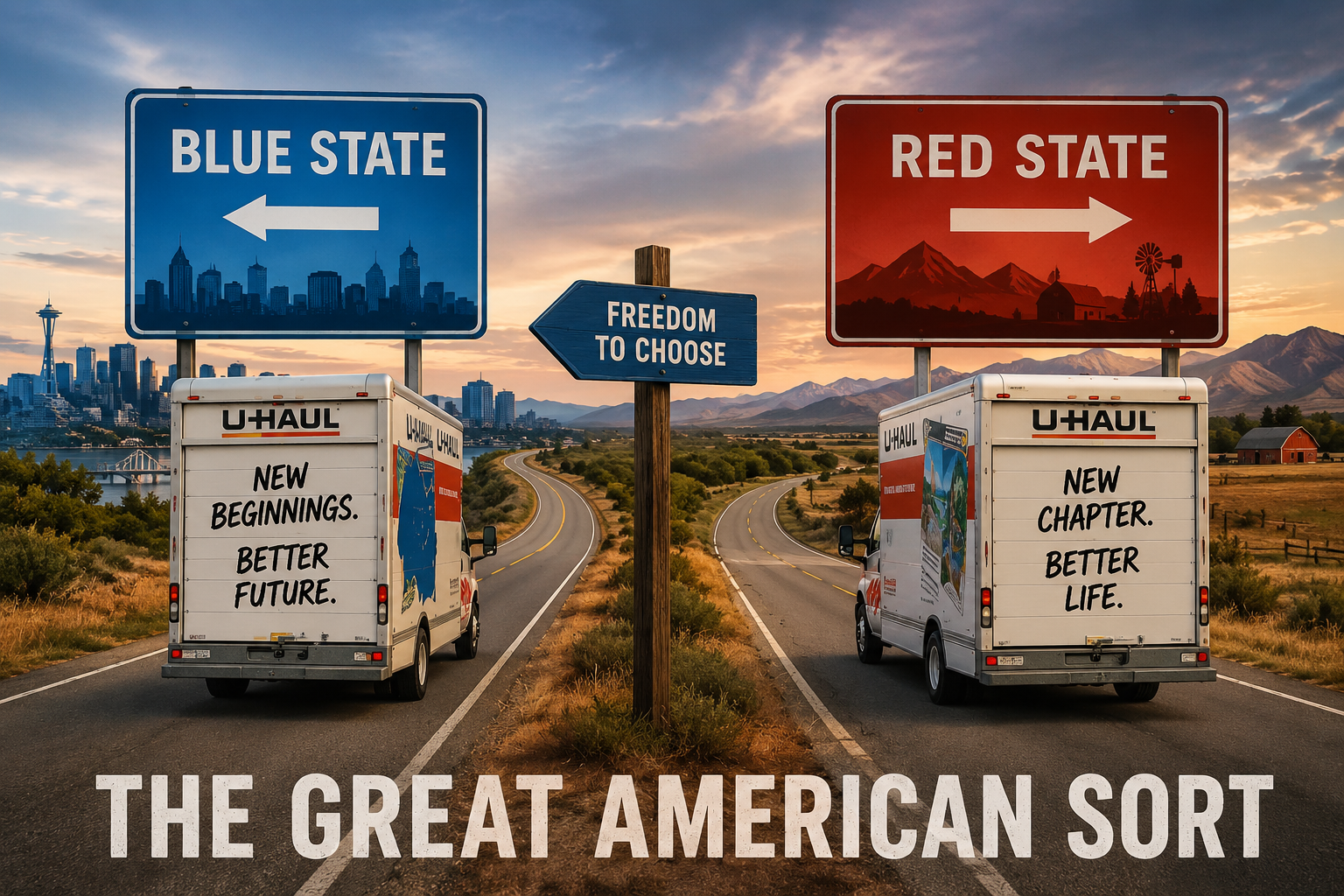
Both people believed life would be better somewhere else. Both packed up their belongings, rented a moving truck, and moved toward communities they believed would better reflect their priorities and values. The politics were completely different. The decision was remarkably similar.
NPR noted that Americans are increasingly clustering together with people who share similar political views. Researchers call it ideological sorting. Perhaps. Yet I suspect politics is only part of the story.

In a country that’s growing ever-more polarized, the shifting demographics cut in both directions — and it is happening across the country. In one study from 2022, researchers concluded that “at no point since the Civil War have partisans been as clustered within individual states as today.”
Research in recent years, however, suggests that the story is more complex and nuanced — and that simply seeking out like-minded neighbors is more often than not just one factor among several driving the shift. – NPR
More Than Politics
Politics today reaches into nearly every aspect of daily life. School policies are political. Tax rates are political. Crime policies are political. Housing development is political. Questions about gender identity are political. Immigration policies are political. Even basic disagreements about what kind of culture a community should embrace now end up on ballots, before legislatures, or in front of city councils.
Those decisions are not abstract. They affect what people see in their neighborhoods, what their children encounter in school, how safe they feel walking downtown, and whether they believe their community is moving in the right direction.
Illegal aliens are slinging deadly drugs on the streets of Seattle, then living the high life in the suburbs wrapped in the warm blanket of Washington state’s sanctuary policies. We wouldn’t even know about it if it weren’t for @DEASEATTLEDiv. pic.twitter.com/GZxQjRg3fQ
— Brandi Kruse (@BrandiKruse) June 8, 2026
When people choose where to live, they are not simply choosing a state or a neighborhood. They are choosing a set of priorities that will shape daily life.
A family leaving California for Tennessee may care about taxes, regulation, and schools. A transgender activist leaving Texas may care about state laws and social acceptance. A retiree moving south may care about affordability and weather. The motivations vary, but the underlying instinct remains the same. People move toward places where they believe they will be happier.
That should not be particularly surprising. Human beings have always sought communities that reflect their values and expectations.
98-year-old beaten with broomstick, chair in NYC by woman campaigning for Dem: copshttps://t.co/4svBnPZ6Pl pic.twitter.com/Ty6EXPf9Wm
— New York Post (@nypost) June 7, 2026
The Contradiction Nobody Talks About
What fascinates me about this conversation is the contradiction hiding underneath it.
For years Americans have been told that diversity is one of society’s highest virtues. Corporations celebrate it. Universities promote it. Activists demand more of it. Government agencies measure it.
Yet when people have the freedom to choose where they live, many appear to make decisions based on familiarity rather than difference.
The conservative in the NPR article wanted a community that better reflected his worldview. The transgender activist wanted exactly the same thing. Neither was searching for more disagreement in daily life. Neither was looking for a place that would constantly challenge deeply held beliefs.
Both were looking for a place that felt like home.
That is what makes the story interesting. The people involved disagreed about almost everything politically, yet both arrived at the same conclusion about how they wanted to live.
Maybe That’s Human Nature
One of the assumptions behind modern diversity initiatives is that people should naturally want to surround themselves with individuals who think differently, believe differently, and live differently.
That sounds admirable until you compare it with how people actually behave.
People build communities around shared interests, shared beliefs, shared traditions, and shared goals. Veterans seek out other veterans. Church members build communities around faith. Families choose neighborhoods based on schools, safety, and quality of life. Nobody finds any of this unusual.
In fact, one could argue that the freedom to choose your community is one of the benefits of living in a free society. People are free to move toward what they value and away from what they do not. The ability to make those choices is not evidence of failure. It is evidence of liberty.
The Great American Sort may not be a sign that something has gone wrong. It may simply be a reminder that people value belonging more than our cultural institutions are willing to admit.
The U-Haul Test
The NPR article calls this trend the Great American Sort. Maybe that is exactly what it is. Or maybe it is simply human nature. The conservative leaving Seattle and the transgender activist leaving Texas disagreed about almost everything. Yet both arrived at the same conclusion: life would be better somewhere else.
What I find interesting is how much effort is spent fighting what appears to be a very natural impulse. We are constantly told that diversity should be the goal, yet people routinely organize their lives around common interests, common beliefs, common traditions, and common expectations. They do it when choosing friends or choosing churches. They do it when choosing schools. Apparently, they do it when choosing states.
Perhaps the lesson hiding underneath all of this is that diversity and belonging are often competing desires. Most people want enough diversity to keep life interesting, but also enough common ground to make a community function.
The irony is that the NPR article was supposed to be about people moving in opposite directions. What I saw was two people making the same choice.
Maybe that’s why the moving trucks keep rolling.
Feature Image: AI-generated illustration.