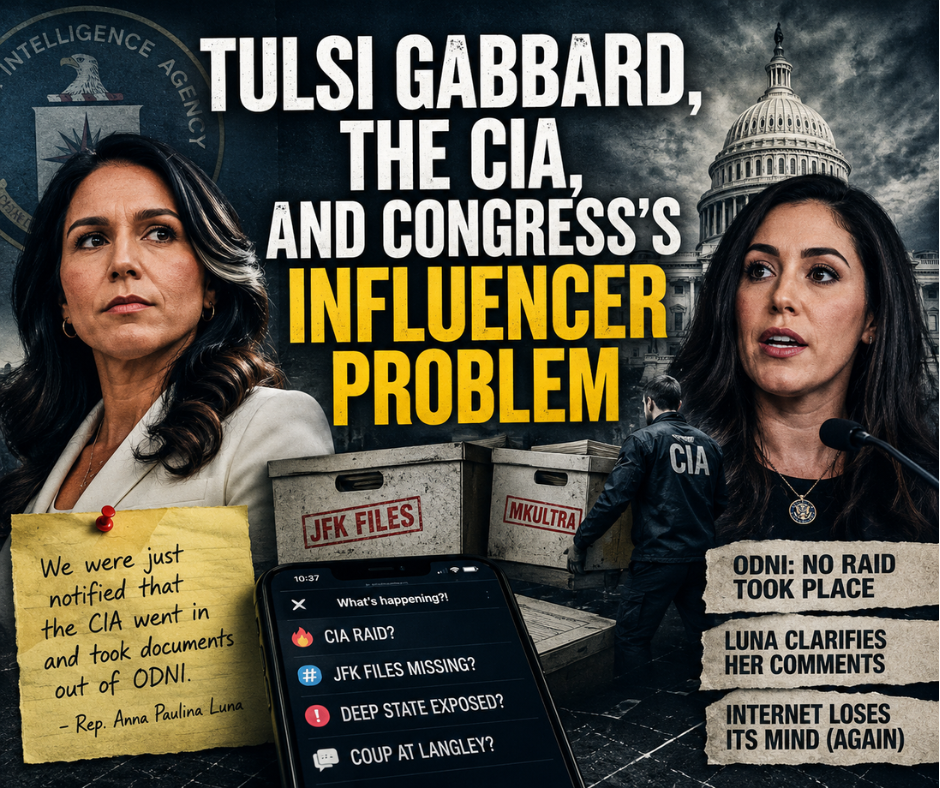
When Anna Paulina Luna went on television claiming the CIA had removed boxes of JFK and MKUltra documents from Tulsi Gabbard’s office, she had to know exactly what kind of reaction those words would trigger online. CIA. JFK files. MKUltra. Tulsi. That is not a normal political update. That is internet catnip. Within minutes, X turned into a digital conspiracy convention and people were openly talking about coups, rogue intelligence agencies, and hidden plots. Which raises the bigger question: why are members of Congress now communicating like viral content creators tossing out dramatic cliffhangers before the facts are even clear?
🚨 JUST IN: The CIA has just SEIZED boxes of DOCUMENTS in DNI Tulsi Gabbard’s office relating to the JFK files and MKUltra, Rep. Anna Paulina Luna says
LUNA: “We were actually just notified that the CIA went in and took documents out of ODNI. Multiple boxes pertaining to the JFK… pic.twitter.com/7l6eMEvaVa
— Eric Daugherty (@EricLDaugh) May 13, 2026
Congress Is No Longer Governing. It’s Producing Content.
Tulsi Gabbard is the Director of National Intelligence. The CIA director reports up through the intelligence structure she oversees. So unless we are now claiming the CIA launched a full-scale rebellion against its own chain of command hours after Trump left the country, maybe we should have slowed down before throwing around words that made half the internet think Jason Bourne was sprinting through Langley.
Instead, social media did what social media always does now. It skipped right past boring bureaucratic reality and headed straight into political thriller territory. Suddenly everybody became an intelligence expert. People were dissecting “missing boxes,” discussing secret operations, and building deep-state theories in real time like Reddit detectives running on espresso and paranoia.
Then came the denials, clarifications, and walk-backs. The Office of the Director of National Intelligence pushed back on the idea that any “raid” happened at all. Luna herself later softened parts of the story. But by then, it did not matter. The emotional reaction had already taken off.
Washington’s new job description increasingly looks like influencer with security clearance.
🚨 BREAKING UPDATE: Despite claims made by Anna Paulina Luna, DNI Gabbard’s office was NOT raided by CIA (or anyone else), WH and DNI officials confirm to me
Luna has since side-stepped her claims as well.
This age of US Reps. saying ANYTHING just for some TV time needs to END.… https://t.co/Qsi3Z6tlN2 pic.twitter.com/m0enTyIoIv
— Nick Sortor (@nicksortor) May 14, 2026
Good for you Nick Sorter, this is one reason why I follow you on X. Thank you!
Washington’s New Job Description: Influencer With Security Clearance
Anna Paulina Luna went on television and casually tossed out the words CIA, JFK files, MKUltra, and Tulsi Gabbard all in the same breath. Specifically, she said:
“We were actually just notified that the CIA went in and took documents out of ODNI. Multiple boxes pertaining to the JFK files as well as MKUltra.”
Within minutes, people online were talking about coups, rogue intelligence agencies, hidden files, and shadow-government operations. Half of X practically turned into a message board full of amateur CIA analysts and people who still think Oliver Stone was making documentaries.
This is becoming a pattern in Washington now. Politicians toss out dramatic little fragments of information in real time, social media fills in the blanks, and then everybody acts shocked when the story spirals completely out of control.
“Internal records handling dispute” sounds like paperwork. “The CIA secretly removed JFK files from Tulsi Gabbard’s office” sounds like a Netflix trailer.
Guess which one people are going to obsess over for the next twelve hours.
Transparency or Performance Art?
What makes this even stranger is that many politicians probably believe this style of communication makes them look transparent. No filters. No waiting. No polished statements. Just jump online immediately and tell the public what you are “hearing.”
But immediacy is not the same thing as clarity.
In fact, it usually creates more confusion. After a while, these politicians start sounding less like people in charge and more like people live-posting their frustration along with everybody else. The only thing missing is one of them recording the video from the front seat of their car while wearing oversized sunglasses and warning everybody that democracy is collapsing before they swing through Starbucks.
Every week there is another dramatic warning, another claim that something shady is happening behind closed doors, another clip designed to send social media into cardiac arrest for six hours. Then nothing ever seems to happen except more talking, more complaining, and another round of people online trying to decode what any of it actually meant.
The Truth Is Somewhere Between The Soundbites
So what actually happened here? Were documents physically removed or not? The DNI says there was no “raid.” Did Tulsi Gabbard ever have the documents in her office in the first place? Was this an internal records dispute that spiraled into internet fan fiction? Or was Anna Paulina Luna told something alarming enough that she felt the need to go on television immediately and say it publicly?
Maybe we eventually get answers. Maybe this story quietly disappears into the giant pile of unresolved Washington drama that gets replaced by the next “bombshell” in about forty-eight hours.
Either way, this entire episode exposed something bigger than missing boxes and JFK files. Washington increasingly communicates like social media now: dramatic first, clarified later, and always one viral clip away from total hysteria.
We used to complain that politicians sounded overly scripted and robotic. Now they sound like influencers live-posting conspiracy threads while the rest of the country tries to figure out what is actually true.
The wild part is how fast people believed it.
Not after evidence. Not after confirmation. Instantly.
Somewhere along the line, ordinary government stopped feeling believable to people. Politics is no longer viewed as bureaucracy, process, and paperwork. It is consumed as participatory entertainment, where every vague soundbite becomes a plot twist and every politician wants to be the main character in the next viral episode.
Featured Image: AI-generated illustration.