At the final hearing of the White House Religious Liberty Commission this week, one phrase took center stage, and not because it was being carefully defined or debated in a measured way. It was being called a lie.
Today was the final hearing of the Religious Liberty Commission. Over the past year, Kelly and the other Commissioners have heard shocking testimonies from individuals whose religious freedoms have been violated.
Be in prayer as the Commission puts together the final list of… pic.twitter.com/NmPeqnEzOC
— First Liberty Institute (@firstliberty_) April 14, 2026
The “Biggest Lie” Claim Lands Loud
Texas Lt. Gov. Dan Patrick didn’t hedge. He called “separation of church and state” the “biggest lie” told since the founding, and the room leaned into that framing as witnesses described how the phrase has been used, in their view, to push religion out of public life.

Chaired by Republican Texas Lt. Gov. Dan Patrick, the capstone hearing spanned five hours and featured panels that also touched on the history of religious freedom in the U.S. and the legal separation of church and state, which Patrick repeatedly dismissed during the event as a lie that is being politically weaponized.
“It is time to set the record straight: there is no such thing as ‘separation of church and state’ in the Constitution,” Patrick said in a statement. “For too long, the anti-God Left has used this phrase to suppress people of religion in our country.”
The lieutenant governor, who leads the commission with Vice Chair Dr. Ben Carson, noted that in all seven hearings of the commission since its establishment via executive order last May, “witness after witness testified that the so-called ‘separation of church and state’ was used to take their God-given religious liberty rights away.” – The Christian Post
That is a big claim, especially for a phrase most people assume is straight out of the Constitution. Shocker, it isn’t.
What the Constitution Actually Says
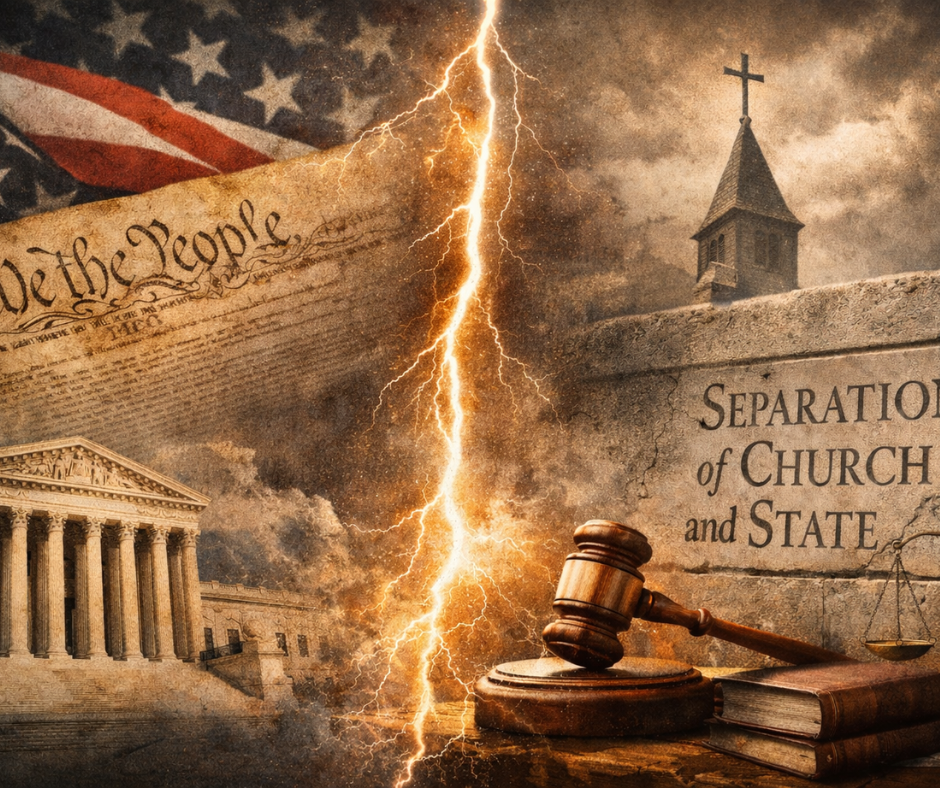
The words “separation of church and state” do not appear in the United States Constitution, the Bill of Rights, or even the First Amendment itself. The actual text is far more restrained, simply stating that Congress cannot establish a religion or prohibit the free exercise of one. That is the boundary. That is the language.
The phrase everyone is arguing about came from an 1802 letter written by Thomas Jefferson to the Danbury Baptist Association, where he described a “wall of separation between church and State” as a way of reassuring a religious minority that the federal government would not interfere with their faith. It was not written as law. And it certainly has not been officially debated, ratified, or codified. It was a letter.
What gets lost in all of this is that Thomas Jefferson wasn’t tossing out some abstract slogan for future political fights. In that 1802 letter, he was tying his point directly back to the First Amendment and making a fairly simple argument: government has no business controlling religious belief. That’s the context for the line everyone quotes—“thus building a wall of separation between church and state.” It wasn’t written as a sweeping command to scrub religion from public life. It was a reassurance that the government would stay in its lane when it came to matters of faith.
When Interpretation Starts Running the Show
That shift picked up real force in 1947 with Everson v. Board of Education, when the United States Supreme Court leaned directly on Jefferson’s language and gave it weight in interpreting the First Amendment. From there, the “wall” did not just exist as a historical reference. It became a guiding concept, one that showed up in decisions about school prayer, religious displays, and the boundaries between public institutions and religious expression.
Somewhere along the way, a phrase from a private letter started getting treated like constitutional text.
Over time, that interpretation showed up in real cases. School prayer was struck down in Engel v. Vitale. Courts developed tests to limit government involvement with religion in Lemon v. Kurtzman. More recently, the pendulum has started to swing back, with cases like Kennedy v. Bremerton School District emphasizing individual religious expression over rigid separation.
When the Argument Hits Real Life
That is the part worth paying attention to, because it explains why a hearing like this one feels less like a policy discussion and more like a collision of completely different starting points. The commission’s witnesses described a pattern of government overreach, pointing to legal conflicts involving religious groups and policies around issues like abortion and gender identity, arguing that the idea of separation has been stretched and weaponized.
“From time to time, this suffering is the result of malice; and recently, from governmental preoccupation with sexual expression,” she said. “Quite often, however, it arises from a misunderstanding of that unfortunate, historically and culturally inaccurate, and constitutionally inapposite Jeffersonian phrase, ‘separation of church and state.'”
Over the next few hours, the commission heard from two panels of other witnesses, some of whom testified how the supposed separation of church and state has been weaponized against people of faith. One witness included Sister Mary Elizabeth, SV, who detailed the legal battle the nonprofit Sisters of Life have faced from the state of New York, which she said “passed a law targeting our ministry to pregnant women.”
“It allowed government officials to force pregnancy centers, but only those that do not perform abortion, to turn over internal documents, including sensitive information about the women we serve,” she said.
Elizabeth also raised concerns regarding the case involving the Dominican Sisters of Hawthorne, New York, who run a Roman Catholic hospice for the poor. The group filed a lawsuit alleging the state violated their constitutional rights by requiring them to affirm the transgender identity of their patients. – The Christian Post
At the same time, there are millions of Americans who have been taught for decades that this same phrase is essential to protecting both religion and government from each other.
Both sides believe they are defending freedom.
They are just not defining it the same way.
That is not a small disagreement. That is what it looks like when interpretation starts doing more work than the text itself.
When Interpretation Gets Revisited
We’ve watched this play out before. When Roe v. Wade was overturned, the real shock wasn’t just about abortion. It was the realization that something people treated as settled law for decades wasn’t untouchable after all. It rested on interpretation, and interpretation can change.
That same question is sitting just beneath the surface here.
How It Expands
No one is arguing that the First Amendment disappears. That’s not the fight. The fight is over how far it reaches and how much weight we’ve given to a phrase that never appears in the document in the first place.
Once a decision like Everson v. Board of Education leans on that phrase, it doesn’t stay contained. Courts repeat it. Schools teach it. Politicians build arguments around it. Over time, it starts to feel like it was always there.
So the question isn’t about tearing anything down overnight. It’s simpler than that. Has this gone further than it was ever meant to?
Where the Lines Break
That’s what this hearing really exposed. Strip away the dramatic language, and what you’re left with is a basic divide. One side sees “separation of church and state” as a necessary boundary that keeps government in check. The other sees it as something that has been stretched far beyond its original purpose and used to push religion out of public life.
Same phrase. Same country. Completely different meanings.
The Real Question
That’s where this gets interesting.
Once a line from a letter starts carrying this much weight—shaping law, shaping culture, shaping how people argue—the question isn’t whether it exists. The question is how it got this powerful in the first place and who gets to define what it means now.
This isn’t just a debate about religion and government.
It’s a debate about interpretation itself.